ASC Advisors June 2026 Newsletter
ASC Advisors June 2026 Newsletter
Welcome to ASC Advisors’ monthly newsletter, where we provide thoughts around recent developments affecting the alternative investment management industry, as well as provide updates on our firm and team.
AI Research Efficiency
While media and other key third parties continue to focus heavily on how alternative investment managers are using AI in investment and risk processes, it is meaningfully changing the way research is being conducted. From ChatGPT and Perplexity to Google’s AI Overviews, limited partners, allocators and counterparties are learning on these tools to form first impressions of alternative investment managers and their leadership.
Stories and information that otherwise would have taken deep research to find are now readily available, and AI summaries pull from whatever exists across the web, including regulatory filings, press coverage, conference bios, litigation records and more. Critically, AI doesn’t consistently distinguish between sources, potentially allocating outsized weight to a decade-old critical article or an out-of-context quote.
What constitutes “low-profile” today is different than it was even months ago, and leaving AI to generate summaries without any engagement can create a dangerous vacuum that can be filled by whatever content happens to exist, or content that doesn’t exist at all but is hallucinated by the AI platform a researcher uses. Proactive profile management has become a strategic imperative, and approaching the effort strategically and selectively can help shape public positioning to present a coherent, consistent image across platforms and with key audiences.
We are in the early days of this evolution, and the strategic communications foundations built and maintained today offer a real opportunity to get ahead and to help ensure consistent messaging through the next iterations of research tools.
The 2026 State of Venture Capital
Venture capital in 2026 finds itself at one of the most consequential crossroads in the asset class's history, with $3.6 trillion in AUM and a number of unprecedented IPOs coming to market over the next several months.
According to PitchBook, AI companies captured 81% of global venture funding in the first quarter of 2026 alone, with nearly three-quarters of all U.S. venture capital flowing into just five deals. That level of concentration is without precedent, and the reliance on these investments has widened the range of possible futures for the industry dramatically. According to The World Economic Forum, projections range from a contraction to $2.8 trillion in assets under management to an expansion as high as $5.5 trillion by 2030.
The firms and founders dominating that landscape would be unrecognizable to venture capitalists from even a decade ago. OpenAI, Anthropic, SpaceX, and xAI have each achieved valuations that dwarf what companies like Google or Facebook were worth at the time of their IPOs.
Deep tech, encompassing everything from AI-driven robotics to advanced semiconductors and small modular reactors, now commands nearly a third of all venture funding. Beyond AI, 2026 has introduced a set of structural shifts that are quietly redrawing the venture map. The "sovereignty first" impulse, which includes nations in the Middle East, Europe, and Southeast Asia investing over $100 billion in localized AI infrastructure is creating new pools of capital and new mandates that look quite different from traditional Silicon Valley ventures.
For now, the entire industry is holding its breath, waiting to see how the markets receive the most consequential set of IPOs in venture history.
Shareholder Activism Trends
Shareholder activism continues to expand well beyond the historical confines of proxy season, with a steady cadence of engagements year-round. The first quarter alone saw approximately 62 campaigns worldwide, down modestly from roughly 70 in the same period last year, with nearly two-thirds of all global campaigns originating in the U.S.
What is notably different this year is who is doing the pushing. Roughly half of all campaigns are being launched by new entrants to the space, including multi-strategy hedge funds, private equity firms, and even long-term shareholders. Many of these newer players were trained at traditional activist funds and are arriving with both sophistication and a willingness to try tactics their predecessors may not have attempted.
Looking ahead to the remainder of 2026, the conditions that have fueled activism show little sign of abating. The rebound in M&A activity, coupled with ongoing market volatility and strong allocator demand, is likely to continue creating opportunities for new entrants, while the revival in strategic transactions and sponsor buyout activity has set the stage for a resurgence in M&A-focused campaigns.
Real Estate Market Flux
The U.S. real estate market remains dynamic, with both domestic and global factors impacting activity. From a legislative angle, lawmakers removed a contested provision from the 21st Century ROAD to Housing Act that would have required major investors (anyone owning more than 350 homes) to sell any newly constructed build-to-rent communities to individual buyers within seven years. With that revision in-place, the House approved the bill, which is now with the Senate for reconciliation before being submitted to the President’s desk for approval. How the final piece of legislation ends up will shape the single-family-home investment market for institutional players moving forward.
Separately, the latest U.S. housing stats revealed that single-family homebuilding dropped sharply in April while mortgage rates increased to their highest point in more than 8 months, up a half a point since the Iran war began at the end of February.
In contrast, on the commercial-side, PERE’s May net-lease report states that the sector continues to offer rare stability. Long leases and strong tenant credit are keeping income streams resilient despite higher rates, and cap‑rate expansion has restored an attractive spread over corporate bonds. Pricing is slowly resetting as buyers and sellers converge, with industrial and essential retail leading performance while office‑heavy assets remain challenged.
For investors, sectors like net lease and essential retail are providing dependable cash flow. The market is recalibrating to a reversal towards higher rates and ongoing geopolitical uncertainty, and investors seem to be favoring stability where it can be found as the lasting impact of legislation and other market influences become more clear.
Firm News
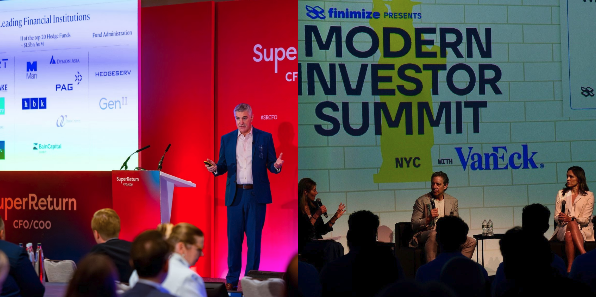
Taylor Ingraham attended the SuperReturn COO/CFO North America Conference in Chicago. On his panel, he discussed executive and corporate positioning across platforms and how to reach key audiences. With so many more ways for LPs, management teams, recruits, regulators and other critical audiences to find information on executives and firms, we're working closely to leverage new tools and strategies to architect differentiated positioning for our clients in the world of Al.
Taylor also attended Upstate Capital's 'Inside the Playbook: How Private Equity is Reshaping Sports,' which is an event for private equity leaders, operators, and industry experts to examine how capital is shaping the future of sports.
Cassandra Dasco attended the Finimize Modern Investor Summit, hosted by VanEck, which brings together local private investors, industry executives, and founders to share candid thoughts about markets.